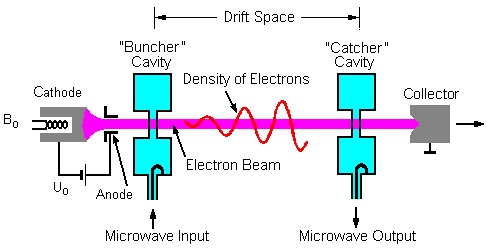
Master the principles of velocity modulation, electron bunching, and microwave amplification through this comprehensive interactive study guide.
Electrons are accelerated or decelerated by RF fields in the buncher cavity, creating velocity variations in the electron beam.
Fast electrons catch up to slow electrons in the drift space, forming density-modulated bunches at the catcher cavity.
Bunched electrons deliver energy to the catcher cavity RF field, producing amplified microwave output power.
Thermionic cathode emitting electrons, accelerated by high voltage (typically 300V-10kV)
Input cavity where RF signal velocity-modulates the electron beam
Field-free region where bunching occurs due to velocity differences
Output cavity where bunched electrons induce amplified RF signal
Absorbs spent electron beam and dissipates heat
Where V₀ is beam voltage, e is electron charge, m is electron mass
β₁ = beam coupling coefficient, V₁ = RF input voltage
L = drift space length, ω = angular frequency
J₁(X) = Bessel function of first kind, order 1
RF input signal creates alternating fields in buncher cavity. Electrons passing during positive half-cycle accelerate; during negative half-cycle, decelerate.
In the field-free drift space, faster electrons catch up to slower ones. Density modulation develops as electrons form bunches.
Bunches arrive at catcher cavity when RF field opposes electron motion. Electrons decelerate, transferring kinetic energy to RF field.
Induced current in catcher cavity is much larger than buncher current. Output power exceeds input power, providing gain.
With X = 1.26, the klystron is operating below optimal bunching. Maximum gain occurs at X ≈ 1.84 where J₁(X) is maximum (0.582).
The output current varies with the bunching parameter X. Maximum output occurs at X = 1.84 where J₁(X) = 0.582.
Output power increases with beam voltage. Typical two-cavity klystrons achieve 10-30% efficiency.
High-power pulsed radar transmitters for air traffic control, weather monitoring, and military applications.
UHF television transmitters requiring stable, high-power amplification with low distortion.
Particle accelerators, plasma heating for fusion research, and medical applications.
| Parameter | Two-Cavity Klystron | Reflex Klystron | Magnetron | TWT |
|---|---|---|---|---|
| Function | Amplifier | Oscillator | Oscillator | Amplifier |
| Frequency Range | 0.25-100 GHz | 1-25 GHz | 1-100 GHz | 0.5-50 GHz |
| Power Output | High (kW-MW) | Low (mW-W) | Very High (MW) | Medium (W-kW) |
| Efficiency | 20-40% | 10-20% | 40-70% | 20-40% |
| Bandwidth | Narrow (1-2%) | Tunable (±10%) | Narrow | Wide (octave) |
1. Principle: The two-cavity klystron operates on the principle of velocity modulation and current modulation. Electrons are first velocity-modulated by the input RF signal, then allowed to bunch in a drift space, and finally deliver energy to the output cavity.
2. Key Components: Electron gun, buncher cavity, drift space, catcher cavity, and collector. The drift space is crucial for converting velocity modulation into density modulation (bunching).
3. Mathematical Foundation: The bunching parameter X = (βV₁/2V₀)(ωL/v₀) determines the degree of bunching. Maximum fundamental current is I₂ = 2I₀J₁(X), occurring at X ≈ 1.84.
4. Performance: Typical power gain ranges from 15-60 dB with efficiencies of 20-40%. The device offers high gain but narrow bandwidth, making it suitable for radar and communications applications requiring high power at specific frequencies.
5. Design Considerations: Optimal design requires careful selection of drift length, beam voltage, and RF drive level to achieve X ≈ 1.84 for maximum power transfer.